Friday, November 02, 2007

The Warehousing of the American Population: U.S. leads world in incarcerations.


"Freedom" may be the slogan of the United States, but the data shows something different. If someone where to ask you where are you most likely to be put in prison, the answer is the United States of America and not by a slight margin. Yes, the U.S. of A. is the world's top jailer. In fact, with only 4.6% of the world's population the U.S. accounts for 24% of the total world's inmates. This is according to the University of London's International Center for Prison Studies.

Here are their statistics
by totals and by rate per 100,000.

*Both lists also include all territories and colonies around the World.*


By total number in Prison
1 United States of America 2,245,189
2 China 1,565,771
3 Russian Federation 889,598
4 Brazil 419,551
5 India 332,112
6 Mexico 216,290
7 Thailand 161,844
8 Ukraine 160,046
9 South Africa 159,961
10 Iran 150,321
11 Indonesia 116,688
12 Vietnam 98,556
13 Poland 89,805
14 Philippines 89,639
15 Pakistan 89,370
16 Bangladesh 86,000
17 Turkey 82,742
18 Rwanda c.82,000
19 United Kingdom: England & Wales 80,229
20 Japan 77,932
21 Germany 76,629
22 Spain 66,129
23 Ethiopia c.65,000
24 Taiwan 64,279
25 Argentina 63,357
26 Egypt 61,845
27 Colombia 60,158
28 Cuba c.60,000
28 Myanmar (formerly Burma) c.60,000
30 France 52,009
31 Kazakhstan 51,538
32 Morocco 50,933
33 Uzbekistan 48,000
34 Kenya 47,036
35 Republic of (South) Korea 46,477
36 Tanzania 43,911
37 Chile 43,723
38 Malaysia 42,389
39 Algeria 42,000
40 Belarus 41,538
41 Peru 40,005
42 Nigeria 39,438
43 Italy 39,348
44 Canada 34,244
45 Romania 32,292
46 Democratic Republic of Congo (formerly Zaire) c.30,000
47 Saudi Arabia 28,612
48 Uganda 26,273
49 Tunisia c.26,000
50 Australia 25,790
51 Sri Lanka 23,613
52 Turkmenistan c.22,000
53 Netherlands 21,013
54 Cameroon 20,000
55 Venezuela 19,853
56 Czech Republic 19,145
57 Georgia 18,138
58 Zimbabwe 17,967
59 Madagascar 17,495
60 Azerbaijan 16,969
61 Iraq 16,308
62 Hungary 15,720
63 Kyrgyzstan 15,127
64 Zambia 14,347
65 Puerto Rico (USA) 14,239
66 Yemen 14,000
67 Israel 13,909
68 Singapore 13,611
69 Libya 13,217
70 Portugal 12,803
71 Ghana 12,736
72 Dominican Republic 12,725
73 Ecuador 12,635
74 El Salvador 12,176
75 Sudan c.12,000
76 Honduras 11,589
77 Panama 11,447
78 Bulgaria 11,436
79 Malawi 11,269
80 Hong Kong (China) 11,211
81 Syria 10,599
82 Greece 10,113
83 Mozambique c.10,000
84 Tajikistan 9,900
85 Afghanistan 9,600
86 Belgium 9,597
87 Cote d'Ivoire 9,274
88 Austria 8,991
89 United Arab Emirates 8,927
90 Moldova (Republic of) 8,876
91 Serbia 8,600
92 Costa Rica 8,427
93 Slovakia 8,380
94 Cambodia 8,160
95 Lithuania 7,983
96 Bolivia 7,682
97 New Zealand 7,644
98 Guatemala 7,477
99 United Kingdom: Scotland 7,261
100 Sweden 7,175
101 Nepal 7,135
102 Burundi 7,022
103 Uruguay 6,947
104 Latvia 6,676
105 Mongolia 6,593
106 Senegal 6,425
107 Paraguay 6,264
108 Nicaragua 6,139
109 Angola 6,008
110 Lebanon 5,971
111 Botswana 5,917
112 Switzerland 5,888
113 Benin 5,834
114 Niger 5,709
115 Jordan 5,589
116 Jamaica 4,913
117 Namibia 4,814
118 Estonia 4,463
119 Haiti 4,443
120 Mali 4,407
121 Albania 4,300
122 Croatia 4,127
123 Papua New Guinea 4,056
124 Laos 4,020
125 Trinidad and Tobago 3,750
126 Denmark 3,626
127 Finland 3,595
128 Norway 3,533
129 Kuwait c.3,500
130 Chad 3,416
131 Armenia 3,342
132 Togo 3,200
133 Ireland, Republic of 3,080
134 Republic of Guinea 3,070
135 Burkina Faso 2,800
136 Gabon c.2,750
137 Swaziland 2,719
138 Lesotho 2,701
139 Mauritius 2,141
140 Macedonia (former Yugoslav Republic of) 2,026
141 Oman 2,020
142 Guyana 1,955
143 Bosnia and Herzegovina: Federation 1,615
144 Sierra Leone c.1,610
145 Suriname c.1,600
146 Bahamas 1,500
147 United Kingdom: Northern Ireland 1,462
148 Belize 1,338
149 Slovenia 1,301
150 Serbia and Montenegro: Kosovo/Kosova 1,199
151 Maldives 1,125
152 Barbados 1,039
153 Bosnia and Herzegovina: Republika Srpska 1,034
154 Central African Republic c.1,000
155 Fiji 967
156 Reunion (France) 962
157 Macau (China) 912
158 Congo (Brazzaville) c.900
159 Liberia 880
160 Mauritania 815
161 Netherlands Antilles (Netherlands) 780
162 Cape Verde (Cabo Verde) 755
163 Luxembourg 744
164 Montenegro 734
165 Guadeloupe (France) 718
166 Bahrain 701
167 Cyprus 662
168 Martinique (France) 649
169 Virgin Islands (USA) 596
170 Guam (USA) 595
171 Brunei Darussalam 522
172 St Lucia 503
173 Qatar 465
174 Gambia 450
175 Djibouti 384
176 St Vincent and the Grenadines 367
177 French Polynesia (France) 354
178 Malta 352
179 Grenada 334
180 Timor-Leste (formerly East Timor) c.320
181 New Caledonia (France) 316
182 Bermuda (UK) 306
183 Dominica 301
184 St. Kitts and Nevis 237
185 Cayman Islands (United Kingdom) 234
186 Aruba (Netherlands) 231
187 Samoa (formerly Western Samoa) 223
188 American Samoa (USA) 222
189 Solomon Islands 211
190 Comoros c.200
191 Antigua and Barbuda 197
192 Jersey (United Kingdom) 176
193 Sao Tome e Principe 160
194 Northern Mariana Islands (USA) 149
195 Seychelles 142
196 Greenland (Denmark) 122
197 Vanuatu 117
198 Mayotte (France) 116
199 Guernsey (United Kingdom) 115
200 Iceland 113
201 Virgin Islands (United Kingdom) 105
202 Tonga 102
203 Palau 97
204 Kiribati 88
205 Micronesia, Federated States of 86
206 Isle of Man (United Kingdom) 79
207 Andorra 61
208 Marshall Islands 43
209 Gibraltar (United Kingdom) 38
210 Monaco 34
211 Cook Islands (New Zealand) 27
212 Faeroe Islands (Denmark) 12
213 Liechtenstein 10
214 Tuvalu 5
215 Nauru 3
216 San Marino 1


By Rate of Incarceration, per 100,000 persons
1 United States of America 750
2 French Guiana/Guyane (France) 630
3 Russian Federation 628
4 St. Kitts and Nevis 604
5 Virgin Islands (USA) 549
6 Cuba c.531
7 Turkmenistan c.489
8 Palau 478
9 Bermuda (UK) 464
9 Virgin Islands (United Kingdom) 464
11 Bahamas 462
12 Belize 461
13 Cayman Islands (United Kingdom) 453
14 Dominica 437
15 Belarus 426
16 Georgia 401
17 American Samoa (USA) 384
17 Barbados 384
19 Grenada 372
20 Netherlands Antilles (Netherlands) 364
21 Puerto Rico (USA) 356
21 Suriname 356
23 Kazakhstan 348
24 Guam (USA) 345
24 Ukraine 345
26 Maldives 343
27 Panama 337
28 South Africa 335
29 Estonia 333
30 Botswana 329
31 Aruba (Netherlands) 324
32 St Vincent and the Grenadines 312
33 Singapore 309
34 St Lucia 303
35 Latvia 292
36 Trinidad and Tobago 288
36 United Arab Emirates 288
38 Kyrgyzstan 285
39 Antigua and Barbuda 284
40 Taiwan 281
41 Namibia 267
42 Tunisia c.263
43 Chile 262
44 Guyana 260
45 Thailand 249
46 Moldova (Republic of) 247
46 Swaziland 247
48 Mongolia 244
49 Poland 236
50 Lithuania 235
51 Brazil 219
52 Libya 217
53 Greenland (Denmark) 216
54 Iran 212
55 Israel 209
56 Azerbaijan 202
57 Mexico 198
58 Gabon 196
59 Jersey (United Kingdom) 193
59 Uruguay 193
61 Costa Rica 187
62 Czech Republic 186
63 Uzbekistan 184
64 New Zealand 183
64 Northern Mariana Islands (USA) 183
66 Jamaica 182
66 Macau (China) 182
68 Cape Verde (Cabo Verde) 178
69 Guernsey (United Kingdom) 176
70 El Salvador 174
70 Seychelles 174
72 Rwanda 170
73 Lebanon 168
74 Malaysia 164
75 Argentina 163
75 Martinique (France) 163
77 Honduras 161
77 Morocco 161
79 Luxembourg 160
80 Guadeloupe (France) 158
81 Hong Kong (China) 156
81 Hungary 156
83 Slovakia 155
84 Mauritius 153
85 Romania 150
86 Tajikistan 149
87 Bulgaria 148
87 United Kingdom: England & Wales 148
89 Spain 147
90 Dominican Republic 143
91 United Kingdom: Scotland 142
92 Peru 139
93 Brunei Darussalam 137
94 Albania 136
94 Gibraltar (United Kingdom) 136
94 Zimbabwe 136
97 French Polynesia (France) 132
97 Saudi Arabia 132
99 New Caledonia (France) 131
100 Kenya 130
100 Kuwait 130
102 Colombia 128
102 Netherlands 128
104 Algeria 127
104 Lesotho 127
106 Cook Islands (New Zealand) 126
107 Australia 125
107 Cameroon 125
109 Samoa (formerly Western Samoa) 123
110 Zambia 122
111 Myanmar (formerly Burma) c.120
111 Portugal 120
111 Reunion (France) 120
114 China 119
115 Serbia 117
116 Vietnam 116
117 Nicaragua 114
117 Sri Lanka 114
119 Tanzania 113
120 Fiji 112
120 Turkey 112
122 Austria 108
122 Montenegro 108
122 Philippines 108
125 Canada 107
126 Armenia 104
126 Isle of Man (United Kingdom) 104
126 Jordan 104
129 Monaco 102
130 Macedonia (former Yugoslav Republic of) 99
131 Paraguay 98
132 Republic of (South) Korea 96
133 Bahrain 95
134 Ecuador 94
135 Croatia 93
135 Germany 93
137 Ethiopia c.92
138 Belgium 91
138 Greece 91
138 Madagascar 91
141 Tonga 89
142 Burundi 88
142 Uganda 88
144 Egypt 87
145 Malta 86
146 France 85
147 Andorra 84
147 United Kingdom: Northern Ireland 84
149 Cyprus 83
149 Malawi 83
149 Sao Tome e Principe 83
149 Yemen 83
153 Bolivia 82
153 Kiribati 82
155 Oman 81
156 Micronesia, Federated States of 79
156 Sweden 79
156 Switzerland 79
159 Benin 75
159 Norway 75
161 Bosnia and Herzegovina: Republika Srpska 74
161 Venezuela 74
163 Marshall Islands 73
164 Ireland, Republic of 72
165 Laos 69
165 Papua New Guinea 69
167 Finland 68
168 Denmark 67
168 Italy 67
170 Slovenia 65
170 Togo 65
172 Serbia and Montenegro: Kosovo/Kosova 63
173 Bosnia and Herzegovina: Federation 62
174 Djibouti 61
174 Japan 61
176 Bangladesh 59
177 Cambodia 58
177 Syria 58
179 Democratic Republic of Congo (formerly Zaire) c.57
179 Guatemala 57
179 Mayotte (France) 57
179 Pakistan 57
183 Ghana 55
183 Qatar 55
185 Iraq 54
186 Senegal 53
186 Vanuatu 53
188 Haiti 52
188 Indonesia 52
190 Mozambique 51
191 Cote d'Ivoire 49
192 Niger 46
193 Angola 44
194 Solomon Islands 42
194 Tuvalu 42
196 Timor-Leste (formerly East Timor) 41
197 Republic of Guinea 37
198 Iceland 36
198 Sudan c.36
200 Chad 35
201 Mali 33
202 Gambia 32
203 Afghanistan 30
203 Comoros c.30
203 India 30
206 Liechtenstein 29
206 Nigeria 29
208 Sierra Leone 28
209 Mauritania 26
209 Nepal 26
211 Faeroe Islands (Denmark) 25
211 Liberia 25
213 Central African Republic 24
214 Burkina Faso 23
214 Nauru 23
216 Congo (Brazzaville) 22

Ethiopia's New Commodities Exchange to Revolutionize African Agriculture

From TEDtalks video description: Economist Eleni Gabre-Madhin outlines her ambitious vision to found the first commodities market in Ethiopia. Her plan would create wealth, minimize risk for farmers and turn the world's largest recipient of food aid into a regional food basket. "There is no place in the world and no time in history that small farmers have had to bear the burden of risk that African farmers bear today," Gabre-Madhin says. "But I'm not here to lament or wring my hands. I'm here to tell you that change is in the air."

Wednesday, October 31, 2007

War against Iran is complete certainty

A new Zogby Poll confirms that despite all, Americans believe the US should bomb Iran. Here is an Excerpt of Zogby's Report:

A majority of likely voters – 52% – would support a U.S. military strike to prevent Iran from building a nuclear weapon, and 53% believe it is likely that the U.S. will be involved in a military strike against Iran before the next presidential election, a new Zogby America telephone poll shows.

The survey results come at a time of increasing U.S. scrutiny of Iran. According to reports from the Associated Press, earlier this month Secretary of State Condoleezza Rice accused Iran of "lying" about the aim of its nuclear program and Vice President Dick Cheney has raised the prospect of "serious consequences" if the U.S. were to discover Iran was attempting to devolop a nuclear weapon. Last week, the Bush administration also announced new sanctions against Iran.

Democrats (63%) are most likely to believe a U.S. military strike against Iran could take place in the relatively near future, but independents (51%) and Republicans (44%) are less likely to agree. Republicans, however, are much more likely to be supportive of a strike (71%), than Democrats (41%) or independents (44%). Younger likely voters are more likely than those who are older to say a strike is likely to happen before the election and women (58%) are more likely than men (48%) to say the same – but there is little difference in support for a U.S. strike against Iran among these groups.


Well I guess there really are no lessons that are not worth learning again. After the invasion of Iraq, I would have expected a higher level of skepticism from the American public, but I was wrong.

The consequences of war against Iran are dire, but a poll such as this during a presidential campaign year will only lead to increase warmongering as each candidate now will attempt to out-war the other. Leading the charge will no doubt be the Republicans, but the Democrats know how to bend with the wind when its convenient, and there is nothing that would be more convenient than winning the 2008 election.

We discussed the possible consequences of war against Iran in a previous post and we stick by that analysis. Unfortunately, reason does not get you votes in American politics.

Click here for the full report from Zogby International

Tuesday, October 30, 2007

184 Countries call for end of Cuban Embargo

For 15 years, every year, the United Nations General Assembly has voted on the issue of the Cuban Embargo imposed unilaterally by the United States. This year's vote was no different with 184 countries calling the embargo an illegal act that must come to an end.

Voting for the measure has become a tradition at the United Nations where Cuban and American dignitaries trade barbs like in a game of ping pong. This year was no different with the US calling for democracy in Cuba and Cuba calling out the hypocrisy of American policies around the world. The vote carried only one abstention and four votes against. Micronesia abstained, while the United States, Palau, the Marshall Islands, and Israel voted against lifting the embargo.

The vote also reminds us of the innate inequalities present in the United nations as a democratic body. When 184 countries, which include Russia, China, and EU members, are unable change such an obvious act of imperialism as is the embargo, there is no more proof needed to say that the United nations must be changed. However that change must come from the bottom not from the top.

Calls for reform are now being fielded by the Secretary General, but only that one proposed by the United States is being given any attention or hopes for ratification.

The Non-Aligned Movement must step forward and reclaim its sovereignty, by first withdrawing from the UN as a form of protest until the General Assembly is given the right to veto the Security Council, as any congress or parliament gets to veto its executive. Only then will a palpable change come to the affairs of the world. And if the United States is truly interested in democracy it must allow this change to occur.

Appeasing America

Appeasement is one of those dirty words we learned from World War II history. Often it is used to denote cowardice, as in the cowardice of 1930's Europe in refusing to confront the expansionist campaign of Hitler and his Nazi Party as they began swallowing up countries left and right. The appeasement of Nazi Germany came to an end when the government of Great Britain decided to draw a line in the proverbial sand by announcing that they would fight to defend Poland. The rest is, well, history.

Today a similar obligation now falls upon the world as the United States pushes forward to attack, possibly invade, the country of Iran. And while folks like Dick Cheney and Norman Podhoretz confuse the issue talking of Iran's President as a Middle Eastern Hitler, it falls upon the international community to ask whether it is time to stop appeasing the United States?

Martin Luther King once described the United States as "a society gone mad with war". Today that seems prophetic under the leadership of the current American Administration. Since 2001, the United States has invaded two countries and deposed their governments, and it has engineered two coup d'etats, one against the elected government of Venezuela and another against Haiti. All the while the world governments have stood aside and allowed these actions and their accompanying crimes against humanity, to happen with little opposition.

There should be no question that if the United States is allowed to attack Iran, there will be others who will be attacked subsequently. Syria and Cuba immediate spring to mind. At some point someone must draw a new line in the sand and proclaim these actions to be criminal. Self-determination and human freedom cannot be allowed to be dictated by Washington, D.C., for their interests are not those of a peace loving nature. The Bush Administration is a leviathan that seeks to impose itself as the sole absolute sovereign over the earth, and is quickly moving to that end.

Despite the rhetoric from the Administration, there is no evidence of Iranian wrongdoing, there is no evidence of weapons of mass destruction in development, there is only the willful and continuous deception of the American people; who for all their strengths easily fall frail under fear. Fear as a manipulation, fear as a tool of government, fear as a resource of war. The people of America are stuck in this muck without any respite thanks to a press and media which refuses to discuss and denounce these actions by the government and have instead become mouthpieces for official policy.

The question then lies with the international community; who will draw the line in the sand and be the first to stop the appeasement of America's belligerent policies? Make no mistake about it, history will judge this generation on this question just as harshly as it has judged Europe in the years prior to World War II.

MLKjr: There comes a time when silence is betrayal

This Martin Luther King Jr. Speech about the Vietnam War is a sober, measured, and determined call for action against war. The words seem as timely today as they were in 1967 when he delivered this speech. Listen closely.

Monday, October 29, 2007

US Eyes African Riches

Latino Insurgent Analysis by Michael A. Deliz


While the world's attention is focused on the Middle East/Central Asia Region. The battle for Africa's oil, between the US and China, has been raging mostly unnoticed by almost everyone. This has not exactly been hidden from the public as much as it has simply been ignored by it, and by the mainstream media's unbelievable inability to piece together what Africa means to the future of the United States' global strategy.

October 1, 2007 marked the first day of active operation for the U.S. African Command (AFRICOM), and it is expected to reach full capability by September of 2008. The establishment of this new unified command of Department of Defense signals an escalation by the United States in its campaign to keep China out of the continent.

"African oil is of national strategic interest to us, and it will increase and become more important as we go forward."-U.S. Assistant Secretary of State Walter Kansteiner III


Theresa Whelan, Deputy Assistant Secretary Of Defense For African Affairs, however stresses AFRICOMs less-imperialistic cover story for being in Africa:

"What we're seeing is more and more drugs being moved through Africa via maritime routes, arms being moved; there's trafficking in persons through maritime routes," she said. "And then of course there's piracy, which is influencing or impacting negatively on international shipping," Whelan added. She also noted the environmental security is "very important for the continent (Africa) economically."


Ok, suddenly the United States, the country which has stonewalled every single international attempt to discuss environmental issues and was just recently found censoring the Climate Change report, suddenly it cares about Africa's environment. And we are supposed to believe that this concern is so great as to need the development of an entirely new branch in the Department of Defense.

Here's an alternative interpretation: The United States is acting upon the 2002 recommendations of the African Oil Policy Initiative Group, AOPIG, here is their full report (in pdf): African Oil Policy

And here is an excerpt:
As a consequence of the impending interplay of U.S. energy security interests and African economic developmental goals, the United States is on the verge of an historic, strategic alignment with West Africa. With projections of over 2.5 million barrels a day in African oil to the American market by 2015, the ambitious goals of the Bush administration’s national energy policy for major diversification of oil supply are within reach. The shift in global energy patterns characterized by massive new production levels in Russia, the Caspian Basin, South America, and West Africa, is contributing to America’s reevaluation of its global alliance system. Within this context, AOPIG believes that West Africa is being projected onto center stage in global affairs.


The implications are simple, where there is a US Regional Command, there will be conflict, and that command is usually never the solution.

Castro: We reply to the false Mambí

Bush, Mambi?
by Fidel Castro Ruz

Viva Cuba libre! (Long live free Cuba!). That was the war cry throughout the plains and the mountains, forests and sugarcane fields, identifying those who began Cuba’s first war of independence on October 10, 1868.

I never imagined that I would hear those words coming from the mouth of a president of the United States 139 years later. It is as if a king of that time, or his regent, were proclaiming: Viva Cuba Libre!

On the contrary, a Spanish warship drew near the coast and with its guns destroyed the small sugar mill, just a few kilometers from the sea, where Carlos Manuel de Céspedes declared the independence of Cuba and freed the slaves that he had inherited.

Lincoln, the son of a poor woodcutter, fought all his life against slavery, which was still legal in his country almost a hundred years after its Declaration of Independence. Adhering to the just idea that all citizens are born free and equal, making use of his legal and constitutional powers, he declared the abolition of slavery. Countless combatants gave their lives to defend this idea against the rebel slave states in the country’s south.

Lincoln is said to have stated: “You can fool some of the people all of the time and all of the people some of the time, but you can’t fool all the people all of the time.”

He died by an assassin’s bullet while, invincible at the polls, he was running for a second presidential mandate.

I am not forgetting that tomorrow, Sunday, marks 48 years since Camilo Cienfuegos' disappearance at sea on October 28, 1959, as he was returning to Havana in a light aircraft from Camagüey province, where days earlier his sole presence disarmed a garrison of simple Rebel Army soldiers whose superiors, of a bourgeois ideology, were attempting to do what Bush is now demanding almost half a century later: rise up in arms against the Revolution.

Che, in a wonderful introduction to his book Guerrilla Warfare, states: “Camilo was the comrade of 100 battles…the selfless combatant who always made sacrifice an instrument for tempering his character and forging that of the troops... he gave the written framework presented here the essential vitality of his personality, his intelligence and his audacity, which are achieved in such exact proportions in just a few figures in history.”

“Who killed him?

“We might better wonder: who eliminated his physical being? Because men like him live on in the people...The enemy killed him; they killed him because they wanted him dead; they killed him because there are no safe planes, because pilots cannot have all the experience they need, because, overburdened with work, he wanted to reach Havana in a few short hours…in his mentality as a guerrilla fighter, not one cloud could hold back or distort a line which had been charted…Camilo and the other Camilos (those who didn’t make it and those yet to come) are the indicators of the people’s strength; they are the highest expression of what a nation may give when on a war footing to defend its purest ideals and with its faith set on securing its noblest goals.”

Because of what their names symbolize, we reply to the false Mambí:

Long live Lincoln!

Long live Che!

Long live Camilo!

by Fidel Castro Ruz
October 27, 2007
7:36 p.m.
Spanish version

U.S. Virgin Islands set to begin 5th Constitutional Convention: Puerto Rico should pay attention


[Latino Insurgent Analysis by Michael A. Deliz]
Today, Monday, October 29, 2007 at 10am the elected delegates to the US Virgin Islands Constitutional convention will begin meetings to draft the territory's constitution. The convention now in its fifth incarnation is required to conclude a completed draft by October 2008, which ultimately leads to a popular plebiscite to be approved by the people of the Virgin Islands. But first it must pass through the imperial filters.


The Constitutional Process

Once the delegates, which have already been selected by popular vote, draft a constitution the document is sent to the territory's governor. The governor then has ten days to deliver it to President Bush. The President will then add his own comments and suggestions (because we all know he is an expert on the needs of the people of the Virgin Islands), and then he forwards it to the US Congress (another bunch of experts!). Once Congress receives it, they have 60 days to review, modify, and approve the constitution which will then be sent back to the Virgin Islands for the constitutional plebiscite.

Essentially the people of the Virgin Islands are going to vote on whether or not to adopt the constitution the US Congress feels is best for them. This is what passes for Democracy in the colonized Caribbean.

Impact on Puerto Rico
For Puerto Rico, this is a process that should be carefully watched as the newly redrafted HR900, or "Proyecto 900" as it is known in the island, begins its process in the halls of Congress. Unlike previous status bills, this one calls for a similar process requiring a Constitutional Assembly to chart the island's future, or possibly find itself decades later still trying to come up with a constitution that pleases both the people and the US Congress like it has happened in the Virgin Islands since the 1960s.

Back in the 1980s, the last time the Virgin Islands went through this process, when the constitution came up for a vote, many voted it down due to differences in opinion regarding what a Virgin Islander is and is not as defined by the document, many simply boycotted the process and failed to vote altogether.

The "Proyecto 900" is different as it begins with a plebiscite to first decide whether the people want a change in status or not. The immediate consequence of that will be the sidelining of the island's Partido Popular Democratico which has traditionally called to maintain the status quo. The PPD, however as of late has been pushing for greater sovereignty as an Associated States, the same basic status as the Northern Mariana Islands. If the PPD sticks to this then that first plebiscite will result in the affirmative to change the island's status.

After that no one really knows what may happen. The statehood party is confident that under those circumstances the people will elect delegates that will opt for statehood. But the Partido Nuevo Progresista, seems to have forgotten one minor detail in their run for power. No one has asked the United States if they want Puerto Rico as the 51st state of the union.

That seemingly preliminary step is one the PNP hopes to deal with once they get a consensus, by whatever means, that Puerto Rico wants to be a state. The plan seems to be that if the people of Puerto Rico choose statehood they can then turn the issue into a Civil Rights fight against disenfranchisement of a minority group. Under those terms it might be easier to appeal to American sensibilities.

In the mean time the United States gets to proclaim that it is doing everything necessary to help the people of Puerto Rico in this process. In truth the US Congress is betting that the Constitutional Assembly will get bogged down into the political quagmire that is Puerto Rico, and leave the island's status as is, while being able to point to the incompetence of the Puerto Rican elite and masses at determining their own future, which is how they see the Virgin Islands.

In other words the Constitutional Assembly prescribed in HR 900 will be nothing more than a black hole of political wrangling. There are really only two alternatives to ending this impasse; either the United States unilaterally declares that it will give Puerto Rico its independence or begin the statehood process, or the island's governor unilaterally declares independence. Anything short of that will only result in a decades long fight that will be relived by every generation to come until either Puerto Rico sinks into the ocean, or the American empire crumbles. If anyone doubts that, go talk to a Virgin Islander.

Sunday, October 28, 2007

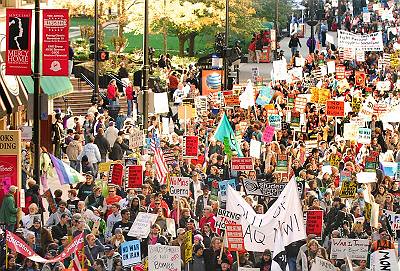
National Day of Protest Against War - Oct 27 Full Coverage Part IV - THE PROTESTS


[Update: attendance numbers have been tallied, 10,000 in Boston, 30,000 in San Francisco, 800 Salt Lake City, 45,000 in New York City, 10,000 in Los Angeles, 2,000 in Orlando, 5-7,000 in Chicago, also 23 cities in Canada held protests]
The protest videos are now beginning to be uploaded as they come in we will be posting them here. [Page maybe slow to load, click on the link after the video to see the full list of videos]
From Sammlyon in Boston:

More Videos...Click below...
From VronRN in Los Angeles

From Alapoet in Seattle

Also from VronRN in Los Angeles

From bluoz.com in San Francisco

From CCProgressives in Maryland

From Jlp1750 in Ottawa

From Zebra334 in Portland on their way to Seattle

From Thelondonfog in London

From jogacoeur

From Labunner1 in Los Angeles

From Oldhacks

More videos to come...